Gilpost · Jung-gu, Euljiro 3-ga
Noodle houseChinese
Andongjang
안동장 Seoul's oldest surviving Chinese-Korean restaurant, open since 1948 and famous for oyster jjamppong
Data as of · Published ·
Andongjang is a Chinese-Korean restaurant run by a Chinese-Korean family, directly outside exit 10 of Euljiro 3-ga station. It opened in Jongno in 1948, moved to this spot in the 1950s, and has passed from founder to son to grandson — three generations. Seoul designated it part of the city's Future Heritage in 2013. What it is known for is gul jjamppong: not the red noodle soup but a white one, thick with oysters and cabbage. Several posts record that it was not on the original menu but was invented in this kitchen in the 1970s. The restaurant fills a whole building, and when the ground floor is full you are sent up to the second or third. It closes at nine on weekdays and eight at weekends. The posts we read run from March to September 2026.
The basics
| Address | 서울특별시 중구 을지로 124 (을지로3가) 124 Eulji-ro, Jung-gu, Seoul |
|---|---|
| Phone | 02-2266-3814 |
| Typical spend | ₩8,000 – ₩16,000 |
| Floor area | 474 m² |
| Status | In business |
6 posts say it is walkable from the station.
When it opens
Of 11 posts: 9 wrote Weekdays 11:30–21:00, 9 wrote Weekends 11:30–20:00.
| Open | Weekdays | 11:30–21:00 9 of 11 posts last seen 2026-09 |
|---|---|---|
| Open | Weekends | 11:30–20:00 9 of 11 posts last seen 2026-09 |
Counted from what bloggers wrote in their posts; we did not confirm it with the restaurant. Where the values differ, it may be a change over time rather than a disagreement, so we show when each one was written.
These hours are counted from the posts we read. Shops change them without notice — check Naver Place before you go.  Place — check hours
What sets it apart
- Being famous, this place attracts a lot of writing by people who never came. Of the twenty-nine posts we collected, nine — one in three — are not accounts of a visit. One was written by a machine and says so in its own voice, explaining which of its "sources" it could and could not verify. Three are price lists dressed as guides. Two are round-ups of five or ten restaurants. Two carry Coupang affiliate adverts in the middle of the text — one breaks off from the oyster jjamppong to sell a walking stick for the elderly. Those nine are out of the denominator. The twenty that remain are what the numbers on this page are built from. Four of those twenty are return visits. One writer has been coming since her father brought her, fifty years of it. One has eaten here so many times that sitting on the ground floor was the novelty — she is always sent upstairs. One comes alone often enough to say the place is easy for that. And one liked her first visit enough to come back within weeks.
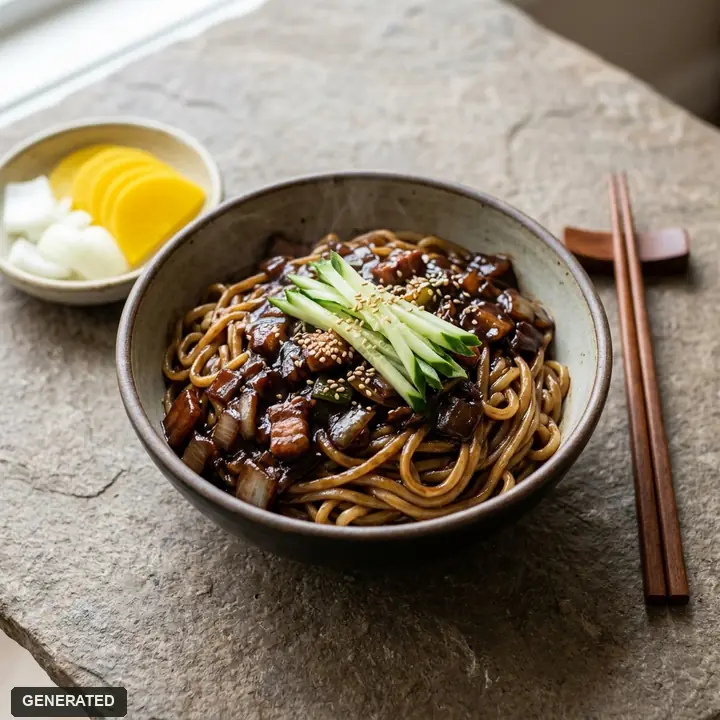
- The famous dish is the oyster jjamppong; the dish people actually order is the ganjjajang. Of twenty posts, ten ate the jajang and seven the oyster soup. What they say about the jajang converges on one thing — it is not sweet the way modern jajang is. One writer came here precisely because she had tired of that sweetness, reasoning that an old Chinese restaurant might be the exception (31367). And then she found it salty. "No sweetness, but the salt surprised me — is that why the modern ones are sweet, to cover it?" Another records the disagreement across her own table, word for word: too sweet for her, not sweet at all and if anything salty for her husband (31382). A third says the jajang served beside the fried rice was salty too. Everyone agrees it is not sweet. On salt, they do not agree.
- Order a cooked dish or the fried rice and a clear soup comes with it, free. Three posts mention it and all three use it the same way, to reset the mouth between dishes; one notices the spring onion in it still crisp (31377). One liked the broth enough that it made her want to order the noodles it properly belongs to (31367). Four posts list the standing banchan: cubed radish kimchi, pickled radish, raw onion and black-bean paste. And one records a member of staff noticing a single piece of pickled radish left on the dish and offering more before she could ask (31378).
What 18 bloggers said
We read all 18 in full. The most common claims are “Returning customer” (4) and “Would return” (4).
What they liked
What they struggled with
Things you can check on site
| Second floor | 7 of 18 posts |
|---|---|
| Reachable by transit | 6 of 18 posts |
| Complimentary starter | 3 of 18 posts |
| Takes reservations | 1 of 18 posts |
These are raw counts, not percentages. Someone who did not mention something is not someone who disagreed.
What people order
The most ordered dish is tangsuyuk (탕수육) — 11 of 18 posts.
The prices here are what bloggers wrote down in their posts, and they may have changed since. Check Naver Place for the current menu and prices. This list is not a menu board — it counts what bloggers actually ordered and ate. Check on Naver Place
What to order
Sides, and what comes with it
Parking
8 posts say you cannot park. None say you can.
| Posts saying you cannot | 8 of 18 posts |
|---|
Do not bring a car. Eight posts say there is no parking, in as many words — no parking, parking unavailable, parking difficult, no car park of its own so take the train. Not one post says there is parking. One writer who tried describes the reality: the public bays nearby are almost always taken and worse on a weekday; there are private lots you can find through an app; and people park in front of shops that are shut at weekends (31367). Nobody gives a price.
Who came, and with whom
| Date | 4 of 18 posts |
|---|---|
| Group visit | 4 of 18 posts |
Getting there
Getting inside
| Second floor | 7 of 18 posts |
|---|
When the ground floor fills, they send you up. Seven posts record eating on the second or third floor. One writer found the whole building is Andongjang, first to third; another was taken to the third floor on both her visits, and watched the staff keep sending people past the older regulars downstairs; a third counts five floors and credits that for how fast the tables turn. Which is why almost nobody waits — one post states it flatly as the reason this is the best lunch room in the district, and the longest wait we read about is ten minutes behind two parties at midday on a weekday. You get up there by stairs — one writer describes climbing them to a booking on the third floor. Not one post mentions a lift.
Nobody writes about getting in with a wheelchair or a pushchair. Across twenty posts the words for wheelchair, pushchair, ramp and threshold never appear. Here, though, the question does not stop at the door — when the ground floor fills you are sent up, one writer describes climbing the stairs to the third floor (31389), and not one post mentions a lift. Whether you get a ground-floor table depends on when you come: one writer found it filling first with older regulars (31377), another has been here many times and had never once sat downstairs (31368). No one looked at the step at the entrance, and no one records another way up.
Nobody has looked at the toilets. The word appears in exactly one of twenty posts, and there it sits in a copied block of amenities — booking, groups, separate toilets for men and women, takeaway (31377). Nothing in that post suggests the writer saw them. So we have not counted it. For a restaurant that occupies a whole building and sends diners up as far as the fifth floor, not one post says which floor the toilets are on. That is not an absence of toilets; it is an absence of anyone who checked.
No one mentioned: In a basement · Lift to the floor · Ramp at the door · Step at the entrance · Step-free access · Toilet inside · Accessible toilet · Separate restrooms. That is not the same as there being none — it means we could not confirm it. Worth calling ahead, and do tell us: we will put it here.
How to read these posts
- Posts saying they paid themselves5 of 18 posts
- Posts saying nothing either way13 of 18 posts
Posts that followed a TV spot
Of the 25 posts we gathered, 7 went up on a single day right after a TV spot and show no sign of a visit. They retell the broadcast, so we left them out of the counts.
We do not discard them. That a TV spot produced a burst of posts is itself something worth knowing about a place, and a star rating will not show it.
When the posts appeared
Month by month
| Month | Posts |
|---|---|
| 2026-03 | 1 |
| 2026-04 | 2 |
| 2026-08 | 3 |
| 2026-09 | 12 |
What we do not know
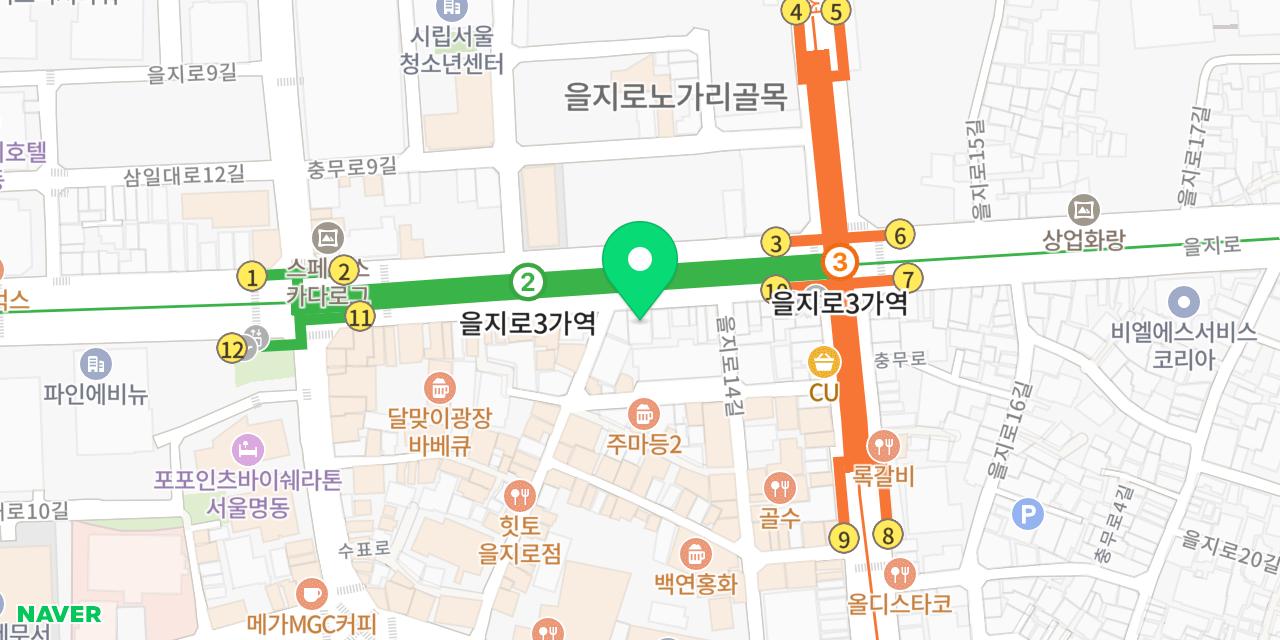
- This is a place you take the subway to. Six posts name Euljiro 3-ga station, and the three that give a distance disagree slightly — about fifty metres from exit 10, seventy-two metres, or simply right outside it. Lines 2 and 3 meet there. Two writers describe walking on to the Cheonggyecheon stream afterwards, one of them for the sun going down between the buildings (31370). Nobody writes about coming by bus.
- You will rarely queue, but they do take bookings. Only one writer in twenty records actually waiting: ten minutes behind two parties, midday on a weekday (31392). One states the opposite as a rule — busy, yes, but so many tables that there is no wait, which is why she calls it the best lunch room around (31368). A third arrived at an odd hour after a long lunch, saw white-haired regulars waiting at the door, and was still seated quickly (31384); a fourth came after the weekend lunch rush and walked in (31387). One group booked ahead and was given reserved seating on the third floor (31389), and three posts note that bookings and large parties are taken. If there are several of you, ring first — the seats are many, but not many on any one floor.
- The door may be shut in the middle of the afternoon. Eleven posts give opening hours, and two of them contradict each other outright about the afternoon break. A post from 21 September records a break from 15:30 to 17:00 (31371); one from 6 September says there is no break at all, and that this is a place where you can drink in the daytime (31384). The other nine say nothing about it. We cannot tell which is true now. The closing time splits once too: nine posts give nine in the evening on weekdays and eight at weekends, while a March post says nine every day (31392). If you are going after lunch, ring first.
- The price range on this page is for the noodles and rice. Jajangmyeon at ₩8,000 up to the abalone-and-seafood fried noodles at ₩16,000, with the oyster and mushroom jjamppong at ₩12,000 and the ganjjajang at ₩10,000. The cooked dishes are counted separately: tangsuyuk ₩20,000 small and ₩28,000 large, prawns in chilli sauce ₩28,000, crisp chicken ₩35,000, pork belly braised in jajang ₩36,000, yangjangpi ₩38,000. They come from a separate book of a menu — one writer photographed a single page of it and gave up, saying there were dizzyingly many (31389). Two writers push back on price. One finds ₩20,000 a little steep for a small tangsuyuk (31382); another, comparing with her own town, says that for the middle of Seoul the oyster jjamppong is cheap (31392). And the ganjjajang is ₩10,000 in an August post and ₩11,000 in a September one — the August writer's transcription of the menu lists a plain version at ₩10,000 and a seafood one at ₩11,000, so we cannot tell whether the September writer ordered the seafood one or whether the price went up.
- The history on this page is what the posts say, not what we verified. That it opened in 1948, moved from Jongno to Euljiro, has passed down three generations of one family, and was named to Seoul's Future Heritage list in 2013 — several posts agree on all of that. More than one also records that the oyster jjamppong was not an opening-day dish but was created in this kitchen in the 1970s; one of those posts works from the Future Heritage record, a 1971 newspaper report and a 2022 interview (31365). That post also flags where its sources disagree: the heritage record dates the move to Euljiro to 1950, the family's own interview to 1956. We do not know which is right. Two posts explain that the Andong in the name is not the Korean city but a place name the founder's family brought from China — one says Shandong, the other names a city within it. Stories about shouting matches in the kitchen, or a chef sending away customers who asked for oyster jjamppong in summer, appear in one post only, with nothing behind them, and we have not repeated them.
- One digit of the phone number is in dispute. Six posts give 02-2266-3814; one gives 02-2266-3921 (31373). That same post also writes the lot number as 315-18 where everyone else, and our own records, have 315-1. Whether both lines exist or one writer mistyped, we cannot say — we list the number the six agree on.
Sources (18)
Every number above was counted from the posts below.
- [안동장] 을지로3가 맛집 1948년 노포 중국집 굴짬뽕 탕수육 군만두 .... 2026-09-22 · 짱구만두의 블로그
- 을지로 회식 80년된 중국집 안동장에서의 굴짬뽕 모험, 호들갑리뷰 2026-09-21 · 호들갑과감성을비벼주세요~
- [을지로3가 맛집] 서울에서 가장 오래된 80년 전통 중국집, 깐쇼새우.... 2026-09-20 · 잔망은지의 하루
- [을지로 3가] 안동장 2026-09-19 · 그냥 한 번 해보기
- (을지로3가) 안동장 2026-09-19 · Rainy의 블로그
- 서울 청계천 나들이와 을지로 3가 화교 중화요리 맛집 '안동장' 내돈.... 2026-09-19 · 뉴요커 John의 블로그
- 서울 노포 맛집 | 종로3가 동대문허파집& 을지로3가 안동장 2026-09-18 · 진짜 하루
- 을지로3가 맛집 안동장 후기|간짜장 탕수육 마파두부, 1948년 노포 .... 2026-09-15 · dbddbd_20
- [중구 을지로 맛집] 안동장 - 새우간짜장, 삼선짬뽕, 고기튀김 Since 19.... 2026-09-14 · 남군의 식도락
- 열쩡 8월 2026-09-11 · 뚠뚠 그것이 나의 길 · via Daum
- [을지로] 안동장 2026-09-06 · voryvorysal님의 블로그
- 을지로 블루리본 노포 중식당 안동장 송이짬뽕 중식냉면 2026-09-06 · 그날의ㄱ 향수 서른마흔다섯 방울...
- [을지로]안동장 을지로 맛집 서울에서 가장 오래된 중식당 2026-08-29 · 고래상어의 picnic!
- [중구/을지로] <안동장> 을지로3가 약 80년 전통 중국집 중화요리 내.... 2026-08-28 · 소소한 식도락 이야기
- 을지로3가 안동장 ,1948년 노포 탕수육과 짜장면 / 내돈내산 2026-08-25 · 다정한 사피엔스
- [서울중구]을지로 중식 노포 맛집 안동장 블루리본 5개 받은 이유 2026-04-12 · 임이에요
- [중구] 을지로3가역 새송이굴짬뽕이 하드캐리한 '안동장' 2026-04-09 · 아그럴수도있겠당~
- 서울에서 가장 오래된 중식당 안동장 후기 굴짬뽕 완뽕 2026-03-19 · 신난닿닿닿
Of 305 candidate posts we opened 69 and kept 18 as evidence. We stop once 30 are confirmed: beyond that the counts grow in proportion without changing the answer.